Endoscopic Surveillance Allows Prediction of Early Signet Ring Cell Carcinoma Burden and Characterisation of Gastrectomy Cohort in Hereditary Diffuse Gastric Cancer
Authors
Hui Jun Lim1, Colin YC Lee2, Nandini Karthik1, Maria O’Donovan3, J Robert O’Neill1, 4, Geoffrey Roberts4, Richard H Hardwick4, Massimiliano Di Pietro1, Rebecca C Fitzgerald1
Affiliations
- Early Cancer Institute, University of Cambridge, Cambridge, United Kingdom
- School of Clinical Medicine, University of Cambridge, Cambridge, United Kingdom
- Department of Histopathology, Cambridge University Hospitals NHS Foundation Trust, Cambridge, United Kingdom
- Cambridge Oesophago-gastric Centre, Cambridge University Hospitals NHS Foundation Trust, Cambridge, United Kingdom
Introduction
Hereditary diffuse gastric cancer (HDGC) is predominantly attributed to CDH1 germline mutation and carries a high cumulative lifetime risk of DGC. Definitive treatment remains prophylactic total gastrectomy (PTG). Endoscopic surveillance is offered to inform decision-making, although optimal time for treatment escalation remains unclear. This study aims to establish whether histopathological assessment of endoscopic biopsies can predict burden of early signet ring cell (SRC) carcinoma on PTG specimens and impact clinical outcomes.
Methods
A retrospective review was performed of endoscopic and surgical histopathologic results of HDGC patients who underwent PTG at a specialist tertiary referral centre between January 2006 and December 2023. All patients had baseline endoscopy and could continue surveillance until PTG was advised by the clinician or preferred by the patient. Patients with DGC (stage 1b or higher) at diagnosis were excluded. Pearson correlation was performed to assess relationship between number of SRC foci on endoscopy and surgical specimens.
Results
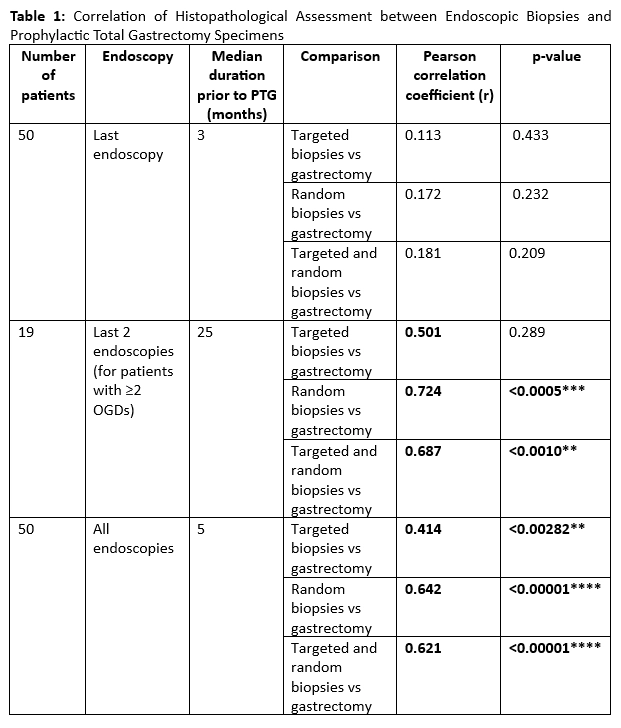
50 patients underwent PTG with median age of 40 and median of 3 pre-operative surveillance endoscopies over 25 months. There was a strong correlation between number of SRC foci on gastrectomy specimens compared with targeted and random biopsies, when evaluated separately and combined, for last 2 and all endoscopies (Table 1) with median duration of 25 and 5 months respectively prior to PTG. The strongest correlation was seen with total number of SRC foci on random biopsies for last 2 endoscopies (r= 0.724, p-value<0.001). Major morbidity due to an anastomotic leak was observed in 1 case (2.0%) with no mortality. Final stage was pT1aN0M0 in 45 patients (90.0%) and pT0N0M0 in 5 patients (10.0%). 5-year overall and disease-specific survival were 100% with median follow-up of 7 years.
Conclusion
Low number of SRC foci at last two endoscopies indicate scarce gastric neoplastic involvement and PTG remains a robust treatment for appropriate surgical candidates.
Keywords
Hereditary diffuse gastric cancer; CDH1 germline mutation; signet ring cell foci; endoscopic surveillance; prophylactic total gastrectomy