Spatiotemporal Genomic Profiling of Intestinal Metaplasia Reveals Clonal Dynamics of Gastric Cancer Progression
Authors
Kie Kyon Huang1,28, Haoran Ma1,28, Roxanne Hui Heng Chong2,28, Tomoyuki Uchihara1, Benedict Shi Xiang Lian1, Feng Zhu2, Taotao Sheng3, Supriya Srivastava2, Su Ting Tay1, Raghav Sundar1,2,4, Angie Lay Keng Tan1, Xuewen Ong1, Minghui Lee1, Shamaine Wei Ting Ho3, Tom Lesluyes5, Hassan Ashktorab6, Duane Smoot7, Peter Van Loo5,8,9, Joy Shijia Chua2, Kalpana Ramnarayanan1, Louis Ho Shing Lau10, Takuji Gotoda11, Hyun Soo Kim12, Tiing Leong Ang13, Christopher Khor14, Jonathan Wei Jie Lee2,15,16,23, Stephen Kin Kwok Tsao17, Wei Lyn Yang17, Ming Teh18, Hyunsoo Chung19,*, Jimmy Bok Yan So20,21,22,*, Khay Guan Yeoh2,23,*, Patrick Tan1,3,24,25,26,27,29,*, Singapore Gastric Cancer Consortium
Affiliations
- Program in Cancer and Stem Cell Biology, Duke-NUS Medical School, Singapore 169857, Singapore
- Department of Medicine, Yong Loo Lin School of Medicine, National University of Singapore, Singapore 119228, Singapore
- Genome Institute of Singapore, Agency for Science, Technology and Research, Singapore
- Department of Haematology-Oncology, National University Health System, Singapore 119074, Singapore
- The Francis Crick Institute, London, UK
- Department of Medicine, Howard University, Washington, DC, USA
- Department of Internal Medicine, Meharry Medical College, Nashville, Tennessee, USA
- Department of Genetics, The University of Texas MD Anderson Cancer Center, Houston, TX, USA
- Department of Genomic Medicine, The University of Texas MD Anderson Cancer Center, Houston, TX, USA
- Department of Medicine and Therapeutics, Faculty of Medicine, The Chinese University of Hong Kong
- Division of Gastroenterology and Hepatology, Department of Medicine, Nihon University School of Medicine
- Department of Internal Medicine, Yonsei University Wonju College of Medicine
- Department of Gastroenterology & Hepatology, Changi General Hospital, Singapore 529889, Singapore
- Department of Gastroenterology & Hepatology, Singapore General Hospital, Singapore 169854, Singapore
- iHealthtech, National University of Singapore, Singapore
- SynCTI, National University of Singapore, Singapore 117599, Singapore
- Department of Gastroenterology & Hepatology, Tan Tock Seng Hospital, Singapore 308433, Singapore
- Department of Pathology, Yong Loo Lin School of Medicine, National University of Singapore, Singapore 119228, Singapore
- Department of Internal Medicine, Seoul National University Hospital, Seoul, Korea
- Department of Surgery, Yong Loo Lin School of Medicine, National University of Singapore, Singapore 119228, Singapore
- NUS Centre for Cancer Research, Yong Loo Lin School of Medicine, National University of Singapore, Singapore
- Division of Surgical Oncology, National University Cancer Institute of Singapore (NCIS), Singapore
- Department of Gastroenterology & Hepatology, National University Hospital, Singapore 119074, Singapore
- Cancer Science Institute of Singapore, National University of Singapore, Singapore 117599, Singapore
- Department of Physiology, Yong Loo Lin School of Medicine, National University of Singapore, Singapore 117593, Singapore
- Cellular and Molecular Research, National Cancer Centre, Singapore
- Singhealth/Duke-NUS Institute of Precision Medicine, National Heart Centre Singapore, Singapore 168752, Singapore
- These authors contributed equally
- Lead contact
Corresponding Authors
Prof Patrick Tan (gmstanp@duke-nus.edu.sg)
Prof Khay Guan Yeoh (mdcykg@nus.edu.sg)
Prof Jimmy Bok Yan So (jimmyso@nus.edu.sg )
Dr Hyunsoo Chung (h.chung@snu.ac.kr)
Introduction
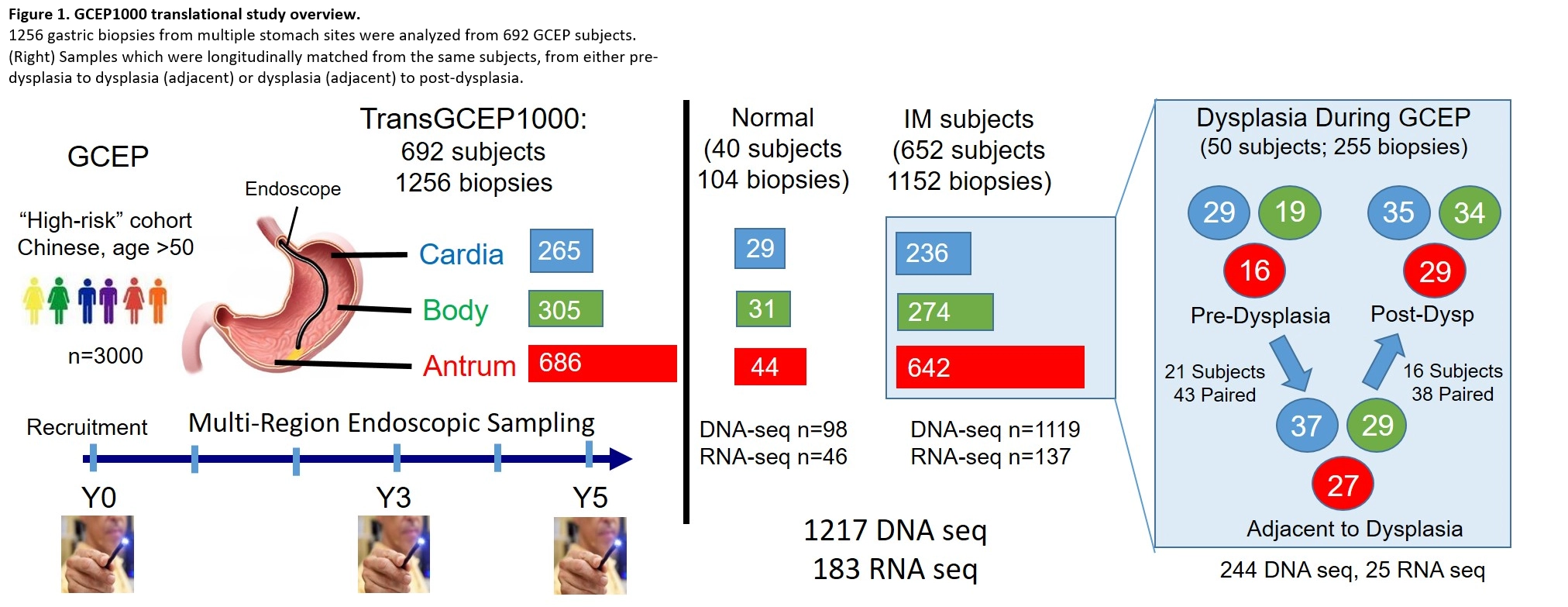
The Gastric Cancer Epidemiology Program (GCEP) is a prospective multi-center longitudinal cohort study, monitoring 2980 Chinese participants aged ≥50 from 2004 to 2015. At enrolment, GCEP subjects underwent screening gastroscopies with standardised gastric mucosal sampling at multiple stomach regions (antrum, body, cardia), and surveillance endoscopies at years 3 and 5.
Methods
For this study (“TransGCEP1000”), we performed high-depth (>1000x) targeted DNA sequencing of 277 cancer genes on 1217 frozen endoscopic biopsies from 682 unique subjects (1119 samples from 644 subjects with intestinal metaplasia (IM); 98 samples from 38 control subjects without IM) (Figure 1). We also generated bulk RNA-seq transcriptomes of 183 gastric samples from the antrum (24 normal, 31 IM) and body/cardia (22 normal, 106 IM) while additional samples (not from GCEP1000) were profiled using single–cell RNA-seq, and spatial transcriptomics.
Results
We identify 26 IM driver genes in diverse pathways including chromatin regulation (ARID1A) and intestinal homeostasis (SOX9). Single-cell and spatial profiles highlight changes in tissue ecology and IM lineage heterogeneity, including an intestinal stem-cell dominant cellular compartment linked to early malignancy. Expanded transcriptome profiling reveals expression-based molecular subtypes of IM associated with incomplete histology, antral/intestinal cell types, ARID1A mutations, inflammation, and microbial communities normally associated with the healthy oral tract. We demonstrate that combined clinical-genomic models outperform clinical-only models in predicting IMs likely to transform to GC.
Conclusion
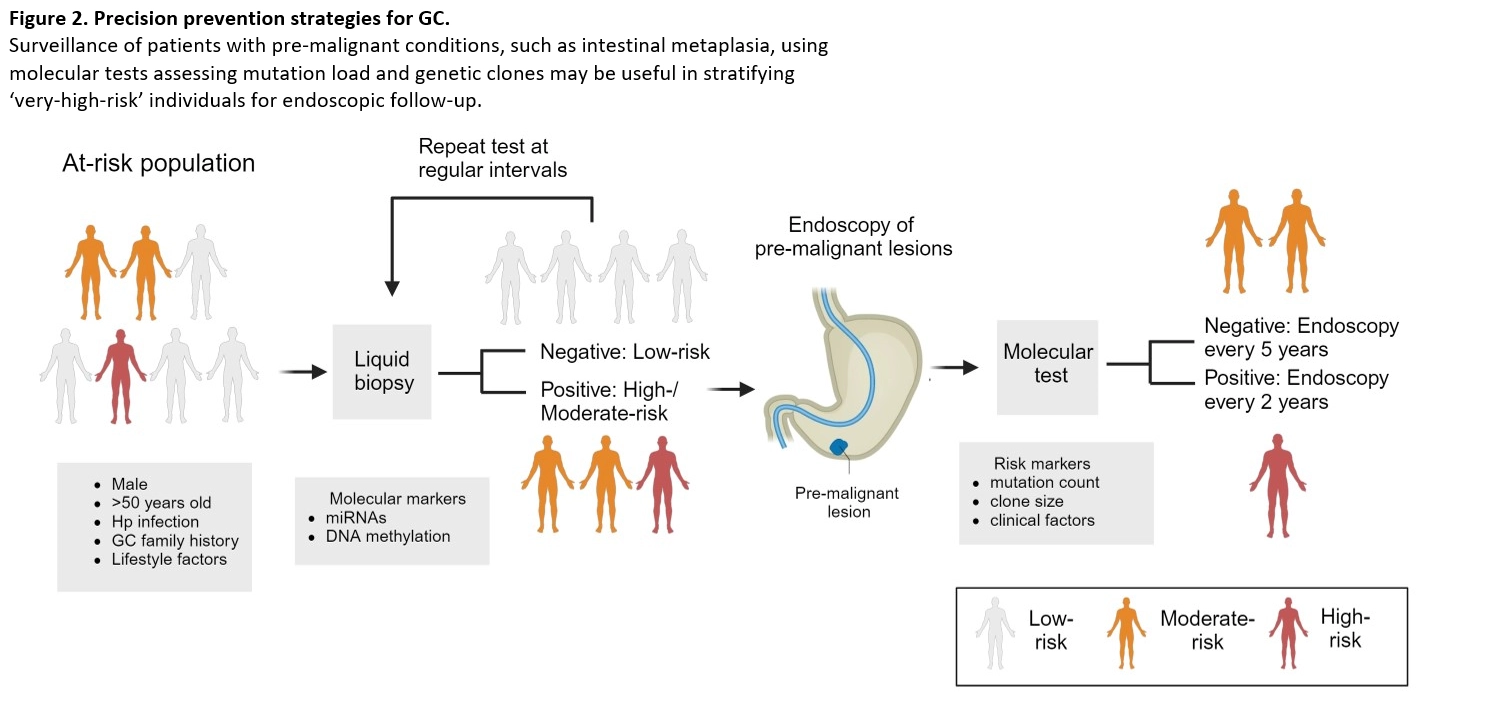
By highlighting strategies for accurately identifying IM patients at high GC risk and a role for microbial dysbiosis in IM progression, our results raise opportunities for GC precision prevention and interception (Figure 2).