Repurposing Cancer Drugs for Other Cancer Types and Investigating Mechanisms Through IQGAP3 Knockouts
Authors
Aashiq Hussain1, Muhammad Bakhait Rahmat1, Yoshiaki Ito1,*
Affiliations
- Cancer Science Institute of Singapore, National University of Singapore, Singapore.
Corresponding Author
Yoshiaki Ito (yoshi_ito@nus.edu.sg)
Introduction
In this study, focus is the repurposing of cancer drugs for different types of cancer, to target genetically heterogeneous tumors. Additionally, we explore the mechanisms of action through IQ motif GTPase-activating scaffold proteins [IQGAP3] knockouts [KOs], aiming to uncover the underlying pathways involved in the drug response.
Methods
The potency of 23 known cancer drugs/inhibitors categorised as inhibitors of receptors, upstream signaling, downstream signaling, DNA synthesis, microtubules, topoisomerases, and histone deacetylases were evaluated again 8 different cancer cell line and one transformed cell line using 3-(4,5-dimethylthiazol-2-yl)-2,5-diphenyltetrazolium bromide [MTT] assay. IQGAP3- KOs were generated by CRISPR and cells were cultured and maintained in RPMI supplemented with 10% fetal bovine serum (FBS), and 0.5 µg/ml puromycin.
Results
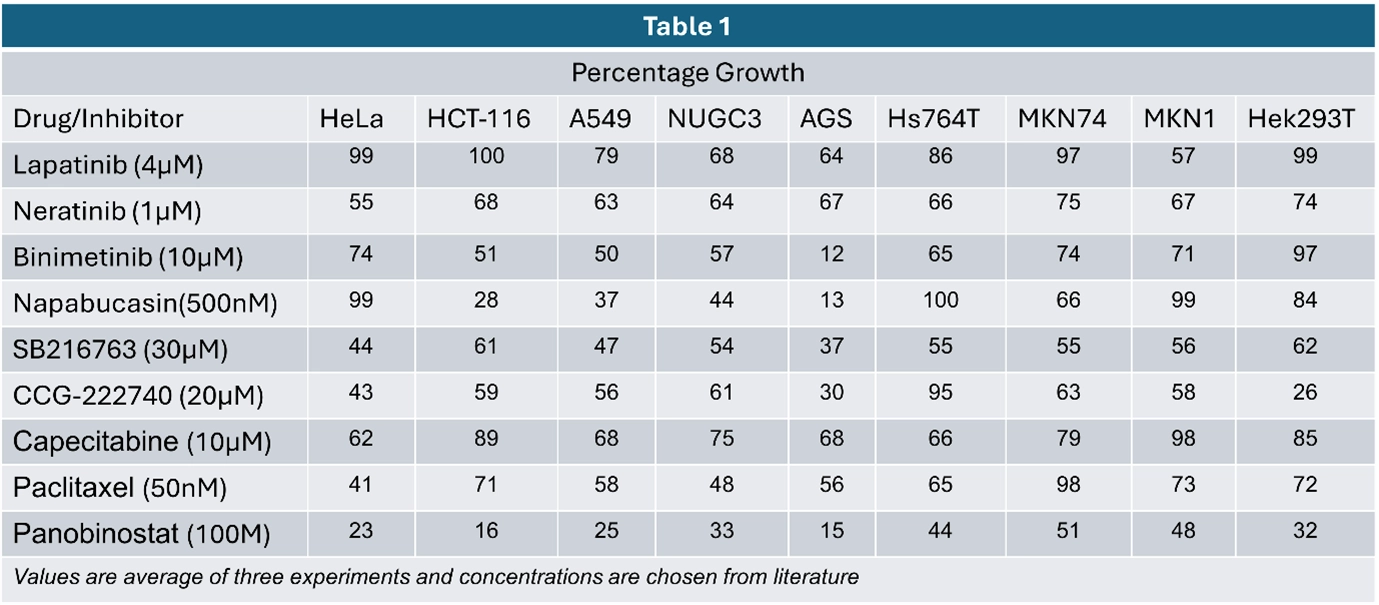
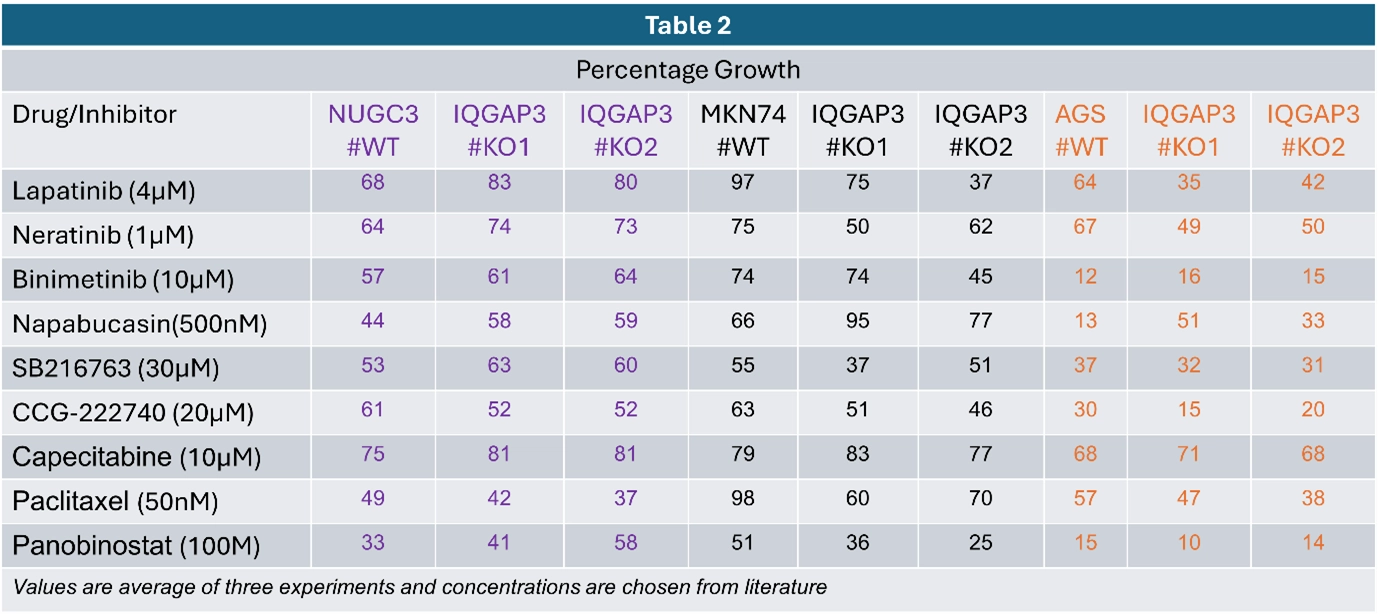
Cell viability assay determined that lapatinib and neratinib as EGFR, HER-2 inhibitor, and pan-HER inhibitor, respectively showed selective potency against some cancer cells used. Similarly, binimetinib and napabucasin as MEKi and STAT3i, respectively were potent. Among downstream pathways inhibitors SB216763 (GSK-3ßi) and CCG-222740 (MRTFi) were efficacious in cancer lines used. Further, capecitabine (DNA synthesis inhibitor), paclitaxel (microtubule inhibitor) and panobinostat (pan-HDACi) inhibited cell growth in selective cancer cell line (Table 1). Furthermore, when analysis, percentage growth in WT vs IQGAP3-KOs of selected gastric cancer [GC] cell lines, napabucasin showed decreased potency in KOs of all three GC cell lines used, hence IQGAP3 downregulation may be required for napabucasin anti-cancer action. Likewise, lapatinib, neratinib and panobinostat decreased potency selectively in NUGC3 KOs while increased in MKN74 and AGS KOs. This specificity may be due to diffuse nature of NUGC3 cancers vs intestinal type of later ones. So, lapatinib neratinib and panobinostat can be used as combinatorial drug in MKN74 and AGS cells.
Conclusion
We aim to identify the effectiveness of repurposed drugs in targeting diverse cancer types and elucidate the role of IQGAP3 in mediating drug responses.